

The Muses on the roof of the Clarendon Building
Nine lead statues of the Muses, each 2.2 metres (just over 7 feet tall) and weighing about a ton, were sculpted to go on the top of Oxford's Clarendon Building, which was completed in 1715. They were reputedly designed by the painter Sir James Thornhill, and Rupert Harris suggests that they may have been produced from his designs by the workshop of Jan van Nost the Elder. Seven of the original statues survive.
The Muses were damaged on the journey by barge from London, and Thomas Hearne records that they “were at first refused, and suffered to lie at the Wharf for above two years; they cost £600” (Reliquiae, p. 380). They were eventually installed in November 1717, and the detail below is taken from an engraving by Michael van der Gucht that dates from that year:
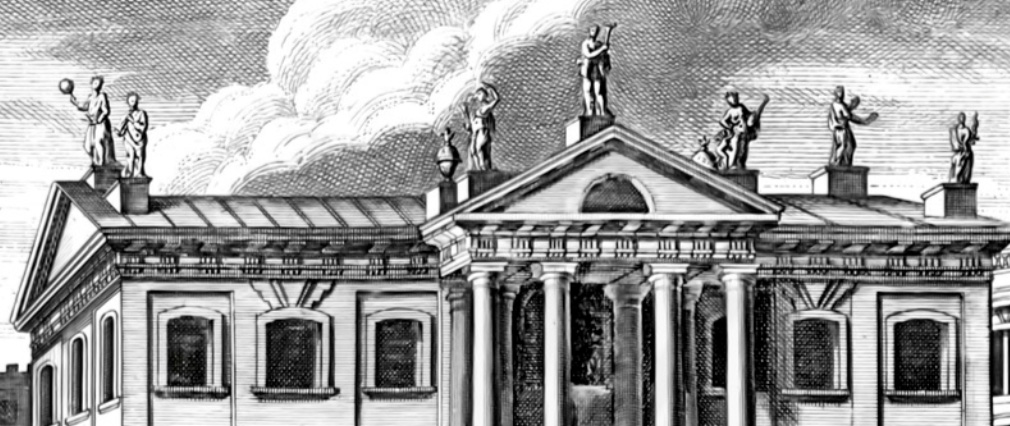
Original positions of the Nine Muses on the Clarendon Building
The oldest and chief of the Muses was placed on her own in the highest central position at the top of the apex:
- Calliope (Epic poetry)
Holding volumes inscribed HOMER and VIRGIL in her right hand and a garland of bays in her left
Fell and was destroyed in 1751
A replacement lead statue was installed on the roof on 5 September 2026
Pair on either side of the front portico:
- Polyhymnia (Rhetoric) on the east (University Press) side
Holding a scroll inscribed SUADERE in her left hand
She was taken down for restoration in 2025/6 and reinstalled on 5 September 2026 - Clio (History) on the west (Bible Press) side
Holding a volume inscribed THUCIDIDES [sic] in her right hand
She was taken down for restoration in 2025/6 and reinstalled on the roof on 5 September 2026
Pair on the western elevation overlooking the Sheldonian Theatre:
- Thalia (Comedy)
Holding a comedic mask in each hand
She blew down in 1935 but was repaired and returned
Currently being restored in situ - Melpomene (Tragedy)
Holding a sword in her right hand
Fell and was destroyed in 1810
Currently being recast
Pair on each side of the frontispiece on the southern elevation:
- Euterpe (Music) to the left
Playing the flute
Currently being restored off-site - Terpsichore (Dance) to the right
Playing the lute
Currently being restored in situ
Pair on the eastern elevation
- Erato (Love poetry) on the north-east corner:
With a lyre in her right hand and a bow in her left
Cupid with an arrow in his left hand reaches up to her bow
Currently being restored off-site
- Urania (Astronomy) on the south-east corner
Holding a globe in her left hand and a pair of compasses in her right
Currently being restored in situ
The two Muses who fell in 1751 and 1810 and were destroyed
Calliope fell from the top of the apex and landed on Broad Street on Sunday 30 October 1751 (two years before the publication of Jackson's Oxford Journal commenced). The following report appeared in the Derby Mercury of 1 November 1751:
On Sunday Morning last, in a violent Storm of Wind, one of the Muses, viz. Caliope [sic], the Goddess of Heroic-Poem, was blown off the Top of the Clarendon Printing-House, several yards into the Street: It was a beautiful Figure cast in Lead, finely decorated, eight Feet in Height, and computed at about a Ton Weight. Several People were passing by, but happily had sufficient Warning to get out of its reach.
Melpomene fell and landed in the area facing the Schools on Saturday 10 November 1810. There was a brief report in Jackson's Oxford Journal on 17 November 1810, but Berrow's Worcester Journal provided this fuller report on 22 November:
On Saturday se'nnight, during the heavy gale, one of the large leaden images, representing the Muses, on the top of the Clarendon Printing-office, Oxford, was blown down, and fell into the area facing the schools, with a tremendous crash. Fortunately no one was passing at the moment, consequently no injury was sustained by any person except poor Melpomene, who was terribly bruised. The weight of the image was nearly a ton, and measured about seven feet high. About 50 years since an accident of a similar nature occurred; one of the statues then falling in Broad-street, which has never been replaced.
G. V. Cox wrote in Reminiscences of Oxford (1868):
1810, Nov. 10. One of the leaden Muses was blown down from the top of the Clarendon; a similar thing had befallen another some few years before [actually 59 years earlier]; the loss however was never made good, and as they were perfectly flattened by the fall, they could not well be replaced. [Footnote:] Of course such a fall did not pass without some attempts at rhyme: e.g.
Look out, Oxonians, one and all,
For here the Muses are of lead:
And when such heavy ladies fall,
'Tis time for each to mind his head.
In 1974 the two fallen statues were replaced by fibreglass replicas made by Richard Kindersley and donated by Blackwell’s, but Calliope was wrongly replaced by a statue of Euterpe, who for fifty years appeared twice on the roof. These replicas are being replaced with the correct lead statues in 2025/6.
The Muse who fell in 1935 and was repaired
Thalia (Comedy) fell on to a stone pillar on the Broad Street side in March 1935, but was repaired and replaced. The Daily Mirror reported on 19 March 1935:
DRAMA IN CRASH DRAMA
Night Watchman's Escape When Heavy Leaden Statue FallsA few moments after he had passed on his round, Mr. C. W. Hatton, a night watchman at the Old Clarendon Buildings in Oxford, heard a terrific crash behind him.
One of the leaden, and more than life size, statues representing the Drama had fallen from its position on the edge of the roof, and had crashed to the ground.
It fell on top of a stone pillar and was smashed into fragments, when Mr. Hatton was only a few yards away.
Restoration in 2025/6
The two missing statues are being remade and the other seven are undergoing restoration. They are being painted in the stone colour that was used originally.
- Four removed for full restoration: Erato (Love Poetry), Euterpe (Music), Clio (History), and Polyhymnia (Rhetoric). The existing armatures will be replaced with stainless steel
The restored Clio and Polyhymnia were returned to the roof on 5 September 2026 - Three undergoing in situ restoration: Urania (Astronomy), Terpsichore (Dance), and Thalia (Comedy)
- Two missing and being replaced: Calliope (Epic poetry) and Melpomene (Tragedy)
The brand-new Calliope was returned to the roof on 5 September 2026
The following approved planning application, submitted in 2023 and relating to the restoration or replacement of the nine Muses, gives a full history and description of all the statues in the "Design and access statement & heritage impact assessment" and the "Clarendon building sculptures report" (under the Documents tab).
- “Conservation repair works to roof & wall mounted statues including: replacement of 2no. fibreglass statues with 2no. new lead statues; temporary removal of 5no. lead statues [4 Muses, plus the Earl of Clarendon] for offsite repair works and reinstatement of statues; in-situ repair works to 3no. lead statues; reinstatement & alteration of lead statue detail. New paint finish to all lead statuary. Stone repair works” 23/01131/LBC)
The three Muses that remained on the Clarendon Building
The photographs below were taken on 7 September 2026 and show the three original lead statues that were not removed during the 2025/6 restoration. These will be painted in situ:
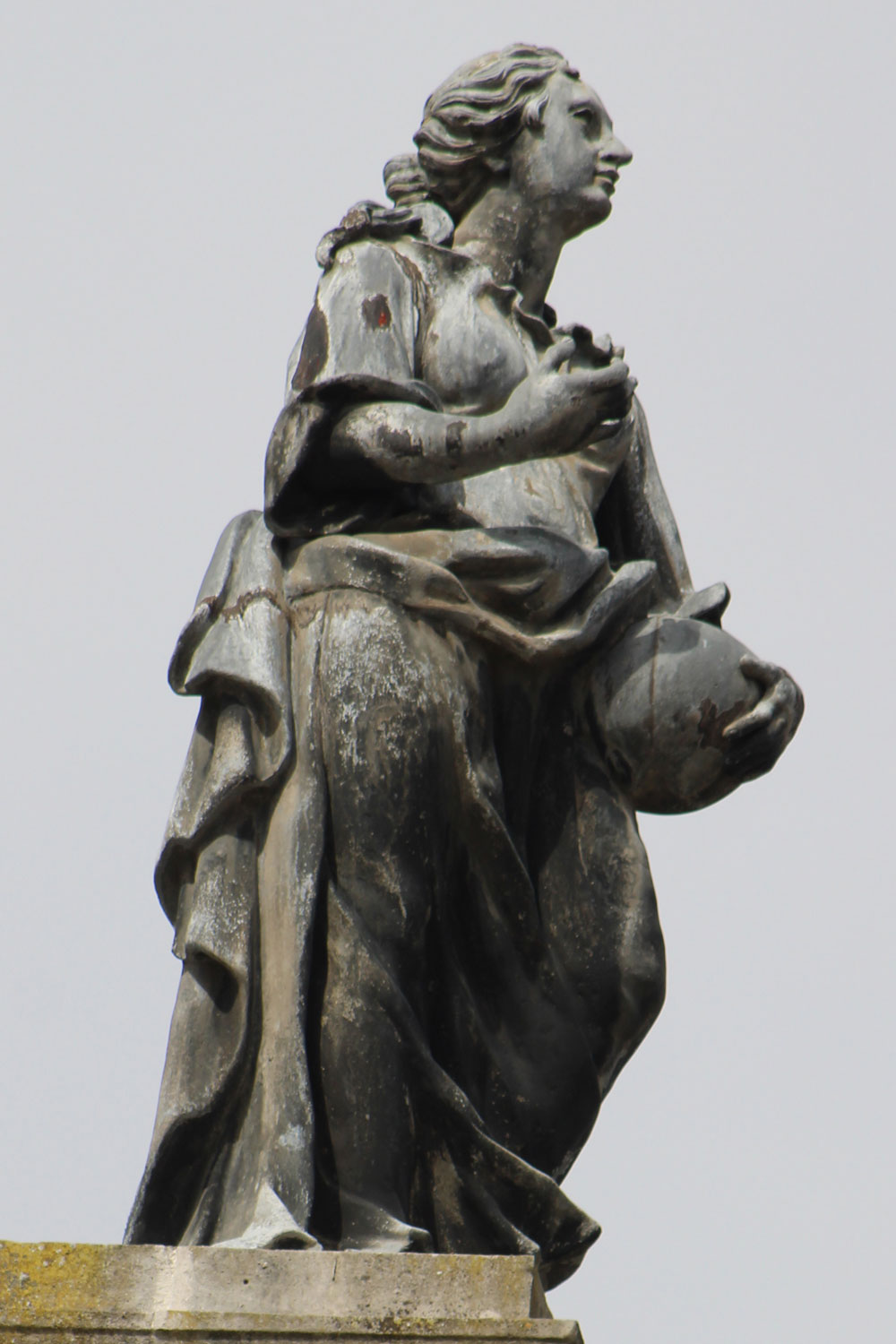 Urania (Muse of Astronomy)
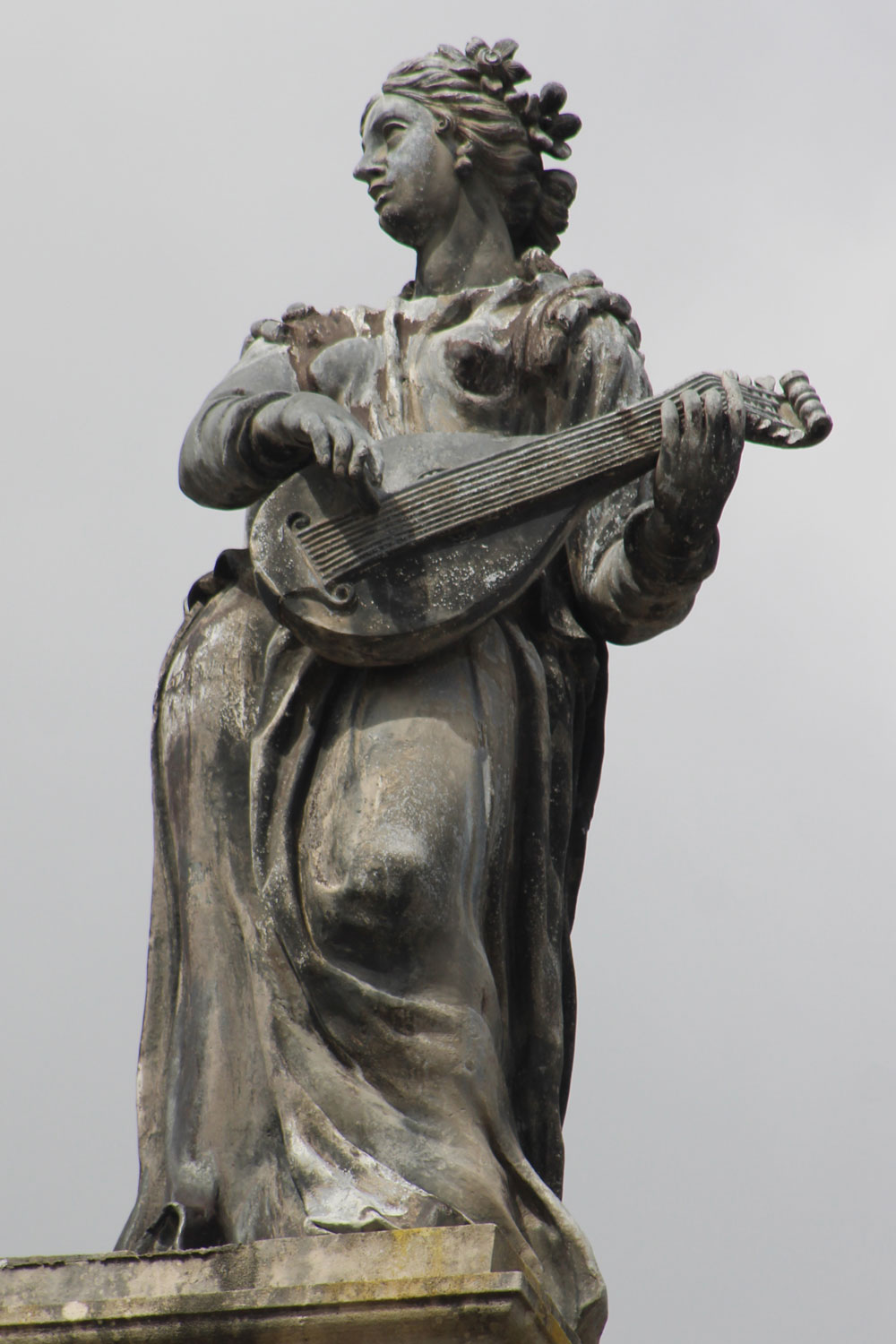 Terpsichore, Muse of Dance
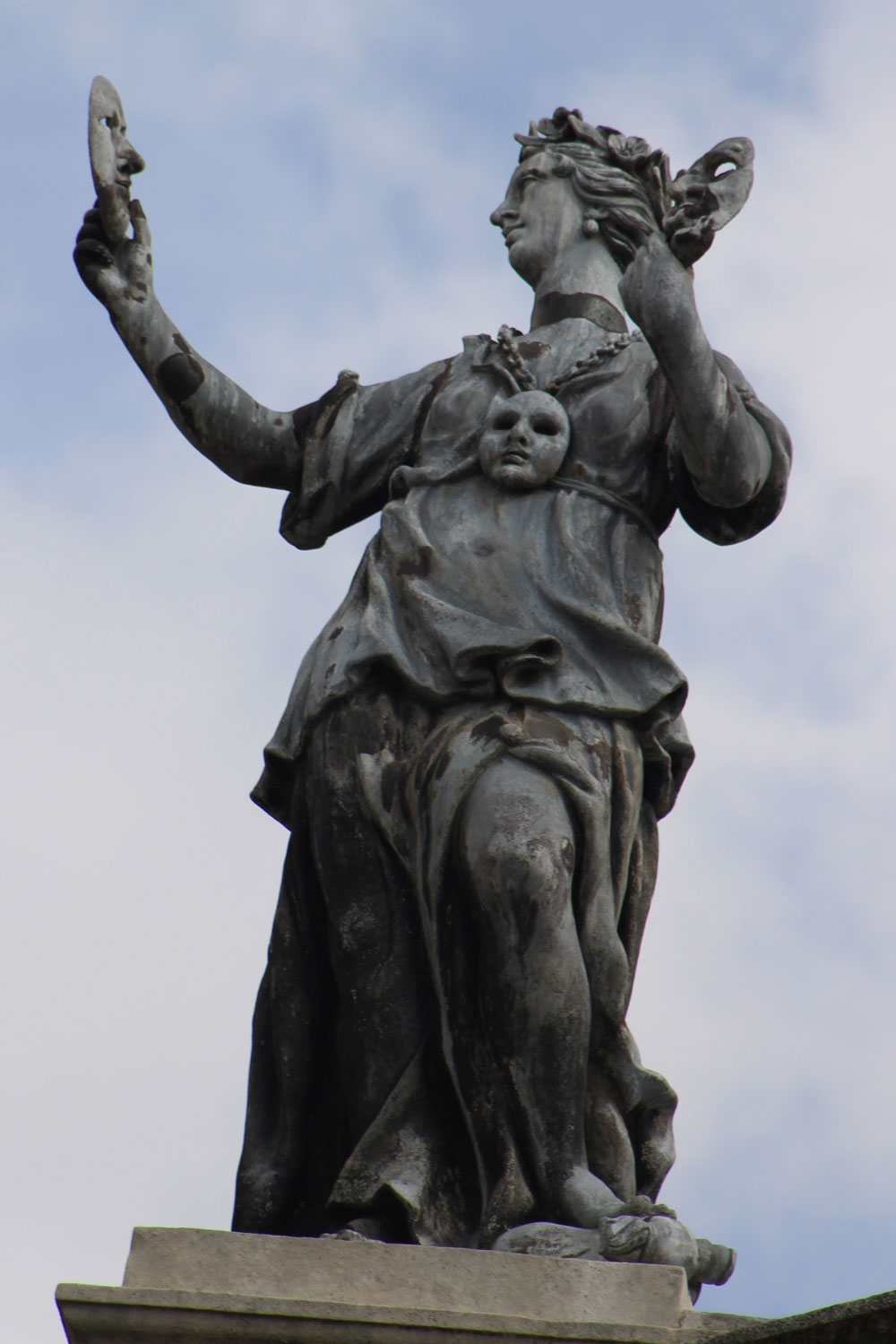 Thalia, Muse of Comedy, who fell down in 1935 but was repaired
The Muses start to return
Three newly painted lead Muses who had been displayed in the Weston Library over the summer of 2026 were returned to the Clarendon Building on Saturday 5 September 2026, but they are still covered by the scaffolding and are not yet visible. Below queuing in Catte Street waiting to be hoisted up are (left to right) the repaired Polyhymnia, the newly sculpted Calliope, and the repaired Clio:

Euterpe, Erato, and the remade Melpomene (as well as Lord Clarendon) will be returned later.