

Clarendon Building
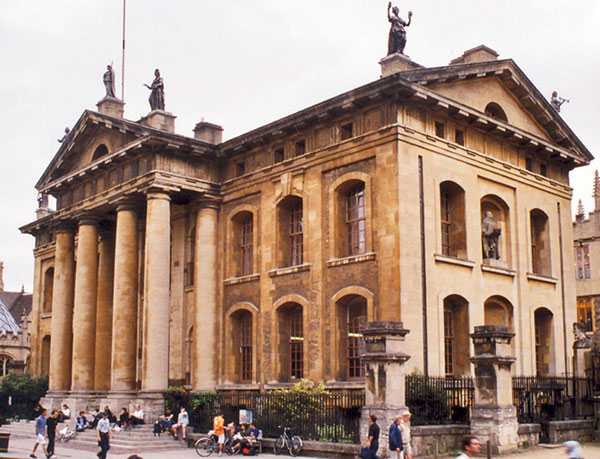
The Clarendon Building was built in 1711–15 to the designs of Nicholas Hawksmoor. It is a Grade I listed building (List Entry No. 1185456).
It was built to house the Oxford University Press, and was known as “The Printing House” or “The Clarendon Printing House” until the University Press moved to Walton Street in 1832. Its name is explained by the fact that it was paid for in part by the profits from the History of the Great Rebellion by Lord Clarendon, whose son presented the University with its copyright.
Lead figures of the nine Muses were placed on top of the building in 1717.
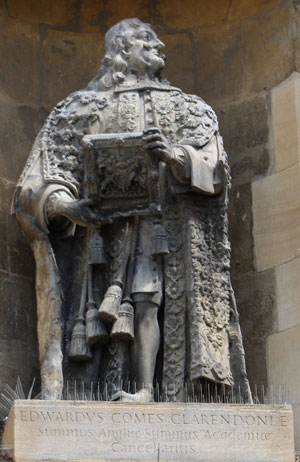
In 1721 a lead statue of Lord Clarendon (left) was placed in a clamshell niche on the first floor of the south side of the building, but this statue was moved to the west side of the building in 1947.
In 2025/6 all ten of these statues are undergoing extensive renovation, with Lord Clarendon and four of the original Muses temporarily removed and the two fibreglass ones being replaced. They will all be painted in the stone colour they would have had originally. This planning application for the project submitted in 2023 (23/01131/LBC) gives a full description of all these statues in the "Design and access statement & heritage impact assessment" and the "Clarendon building sculptures report" (under Documents tab).
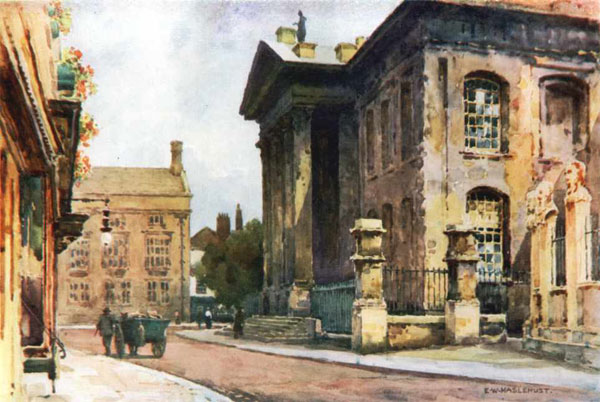
Below: The Clarendon Building viewed from the south
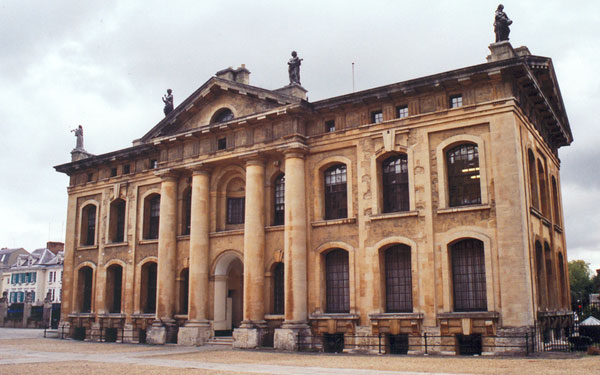
In 1829 the University police took over part of it as their police station: the cells were in the basement. It became known as the Clarendon Building after it was adapted by the University for use as a registry in 1832. It continued as the university registry until the present University Offices were opened in Wellington Square in 1975. The Clarendon Building is now mostly used as offices of the Bodleian Library.
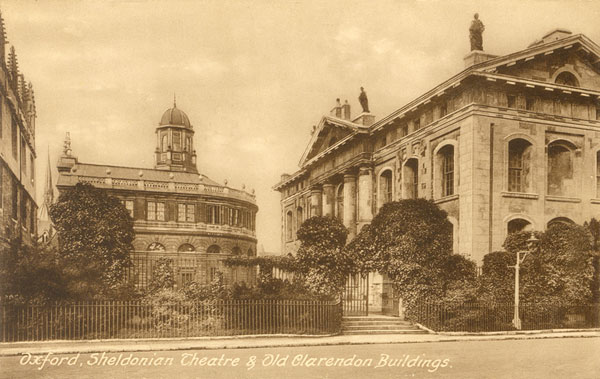
In 1896 it housed the Registrar of the University, the Secretaries of the Curators of the Chest, of the Boards of the Faculties & Studies, of the Oxford Appointments Committee, of the Association for the Education of Women, and of the Local Examinations Delegacy, and the controller of the Lodging Houses Delegacy. There was also a Delegates’ Room
Kelly’s Directory for 1891 describes the building thus:
The Clarendon building, situated at the eastern end of Broad street, is a stately but somewhat heavy rectangular structure in the Classic style, erected in 1711–13 from the profits of the sale of Lord Clarendon’s “History of the Rebellion”, and was designed by Nicholas Hawkesmoor, one of Wren’s pupils.; the building is pierced by an arched passage way and is approached from the street by a broad flight of steps supporting a lofty portico, with pediment and pillars of the Tuscan order: from October 1713 to September 1830 it served as the University Press, but is now occupied by the offices of the University Registrar and University Chest, and includes also offices for the use of the Proctors: over the south entrance is a fine statue of Edward Hyde, Earl of Clarendon and Lord High Chancellor, in his robes of office.

Right: This fire insurance mark is high on the south side of the Clarendon Building. Sun Insurance Policy No. 16839 dates from c.1717
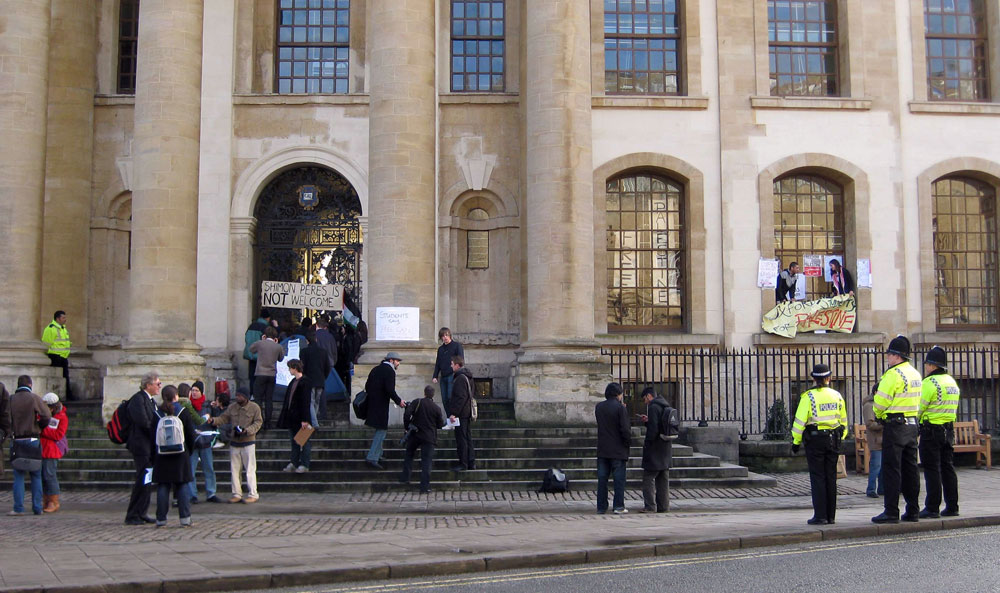
Although the Clarendon Building has not housed the University Registry since 1975, it is still a popular site for student protests, and was occupied by 80 students in January 2009 condemning Israel’s military actions in Gaza and a lecture series at Oxford inaugurated by Israeli president Shimon Peres:
Print of 1717 by artist & engraver Michel van der Gucht
showing lions flanking the steps up to the Clarendon Building
Painting of the Clarendon Building in 1755
by John Donowell (Yale Center for British Art)