

Oxford post boxes: brief history of the post box
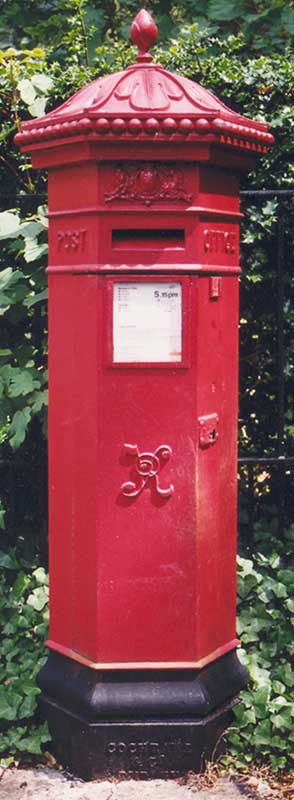
When Rowland Hill first introduced the Penny Post in 1840, his idea of using boxes to collect letters was not adopted, and people had to take their letters to their nearest post office.
Twelve years later, in November 1852, the novelist Anthony Trollope (who had been sent on special Post Office duties to the Channel Islands) introduced the French-style pillar box to Jersey. The next year the idea spread to mainland Britain, with England’s first pillar box erected at Botchergate in Carlisle in 1853.
On 5 May 1858 Jackson's Oxford Journal published the following report of the meeting of the Street Commissioners two days earlier:
Mr. Warne, master of the Post-office, attended before the Board and stated that the Postmaster-General had provided two pillar letter boxes for the accommodation of the inhabitants, and it was proposed to place one opposite the Angel Hotel, near Queen's College, and the other close to [St Mary] Magdalen Church. On the motion of the Chairman, it was agreed to recommend that one box should be placed at the end of Long Wall, instead of near Queen's College, and that the Post-master-General should be requested to furnish six more pillar boxes or receiving houses.
In an inquest in the same newspaper on 11 September 1858, a servant living in Park Town states at an inquest that he put a letter from the deceased “into the new pillar letter-box at the end of Magdalen Church-yard”.
From 1859 a single style of pillar box was adopted for the whole country and in 1866 J.W. Penfold was commissioned to design the new standard pillar box that is still known by his name today. This hexagonal box, produced in three sizes by Cochrane, Grove & Co of Dudley, was the first box to be painted red.
Roadside wall letter boxes first appeared in 1857 as a cheaper alternative to pillar boxes, especially in rural districts. The first wall boxes were manufactured by Smith & Hawkes, and many had narrow posting apertures which had to be widened in subsequent years.
A selection of reports published in Jackson's Oxford Journal about new letter boxes in Oxford
6 January 1878:
NEW POST OFFICE LETTER BOX.—The Post office authorities have this week placed a letter box in the wall of the house, No. 100, Holywell-street, which is situate at the junction of that street with Long Wall-street, and the road leading to the Church. The new box will be a great convenience in the locality, and the hours of clearing are 9.30 a.m., 2.20, 5.30, 7.15, and 0.0 p.m. on week days, and 2 p.m. on Sundays.
4 February 1882:
The [General Purposes] Committee have received from the Postmaster an application to allow a pillar letter box to be placed in the High-street at the corner of King Edward-street. The Committee recommend that permission be given, but they consider it advisable that the letter box should be placed in King Edward-street, a short distance from the corner, instead of in High-street, if this can be arranged.
25 November 1882:
The [General Purposes] Committee recommend that permission be given to the Postmaster to remove the pillar letter-box opposite Queen's College, to the site of the old turnpike, the Plain, St. Clement's: also to erect a new pillar-box at the corner of Crick and Fyfield Road.
21 November 1885:
[The General Purposes Committee recommended] That permission be given to the Postmaster to erect a pillar letter box on the corner of Banbury and St. Margaret's Roads, in such position as the Chairman and Surveyor shall approve.
10 December 1892:
Your [General Purposes] Committee report that they have received a letter from the Postmaster, asking permission for the erection of a pillar letter-box in Queen-street, in the fence of the disused churchyard of St. Peter-le-Bailey, and recomend that the sanction of the Council be given to the proposal so far as the interest of the Corporation in the ground proposed to be used is concerned.
- Letter Box Study Group
- Unofficial history of British letter boxes by Paul Wicks
- BBC News, 15 July 2015: Forensic tagging to help preserve UK's post boxes