

Richard Ferdinand Cox (1786–1845)
Mayor of Oxford 1826/7
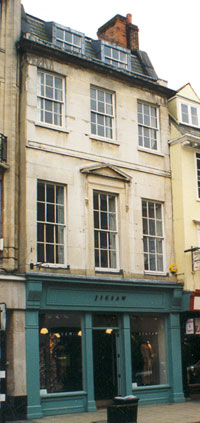
Richard Ferdinand Cox was born in Oxford and baptised on 1 October 1786 at All Saints’ Church. He was the son of the banker Richard Cox (who was himself elected Mayor in 1799, 1812, and 1823) and Mary Adams. His two older sisters Harriet and Louisa Sarah Cox and four younger siblings James Henry, Julia Lavinia, Mary, and Charles Henry Cox were also baptised at All Saints.
Richard Ferdinand Cox joined his father in business as a linen draper in All Saints parish at 134 High Street (right). Cox & Co were bankers as well as drapers.
In April 1801 Sir John Treacher was granted a licence of alienation to assign Richard Ferdinand Cox a cellar under the Town Hall.
On 14 December 1807 Richard Ferdinand Cox was admitted free by virtue of his being the eldest son of the banker Richard Cox, and in that year he and his father went into partnership with the cousins James and Robert Morrell to form the bank Cox, Morrell & Co.
Richard Ferdinand Cox was elected on to the city council in October 1810.
On 24 August 1812 at St Michael-at-the-Northgate Church, Richard Ferdinand Cox, described as a banker of the High Street, married Sarah Folker (born 1787, the only surviving child of William Folker, Mayor in 1802 and 1816). They appear to have had just one child:
- Louisa Sarah Cox (born in Oxford and baptised on
31 July 1813 at All Saints’ Church)
Richard Ferdinand Cox was elected Senior Chamberlain for 1813/14 and Senior Bailiff for 1818/19, and one of the eight Assistants on 2 December 1825. In January 1826 he was appointed a Justice of the Peace.
On 18 September 1826 Cox was elected Mayor of Oxford (for 1826/7).
He continued to serve as an Assistant, and on 30 March 1828 he was elected on to the Council's Market Committee.
His financial problems began around this time. To finance their investments and purchases of land, all the partners in Cox, Morrell & Co borrowed from the bank’s joint funds. In 1831 (probably when the accounts were made up) the Morrells discovered that Richard Ferdinand Cox had not only borrowed £14,000, but had contravened their express wishes by lending over £25,000 to a Witney carrier called Richard Parker.
While his father Richard Cox had fled as a bankrupt to Calais in 1833, Richard Ferdinand Cox appears to have moved to Regent Square in St Pancras, London after he was expelled from the partnership with the Morrells, taking his shares in the bank premises and profits in compensation. He was now described as a coal owner, and he appears to have owned a colliery jointly with David Davies of Lydney, Gloucestershire. This was the Kidnalls at Lydney in Gloucestershire, which was put up for auction on 19 May 1838, and along with the colliery, a policy assurance numbered 6500 with the Law Life Assurance Society was put up for sale “for payment of £5000 on the decease of Richard Ferdinand Cox, aged about 52 years: annual premium, £233 15s”.
Richard Ferdinand Cox continued to serve as a Mayor's Assistant to the end of the Old Council in December 1835.
On 21 December 1838 the following notice appeared in the London Gazette:
25 December 1838: BANKRUPTS. David Davies, late of Lydney, in the county of Gloucestershire (but now a prisoner in the Queen’s Bench prison) and Richard Ferdinand Cox, late of High-street, Oxford, in the county of Oxford, but now of Regent-square, in the parish of St. Pancras, in the county of Middlesex, coal-owners, d.c. to sur. Jan. 15, and Feb. 5, at 11.—Sols. Richard and Motteram, Birmingham. —Pet. cr. Robert Pike, of St. John-street, Oxford, sheriff’s officer.
He was still described as a coal owner of Regent Square in July 1840, but he held on to his land at Botley, as electoral registers for Berkshire between 1840 and 1855 show that Richard Ferdinand Cox of the High Street, Oxford and his brother Charles Henry Cox of Benson each owned “One Moiety of £6 a Year, Land Tax of 70 Acres of Land” situated at Seacourt, originally occupied by Thomas Ainsworth in 1840, and then in 1850 and 1855 (the latter year oddly after Cox's death) by Thomas Ensworth.
Richard Ferdinand Cox is hard to find in the 1841 census, but his wife Mrs Sarah Cox and their unmarried daughter Louisa (who was then about 28), both described as independent, were living at 134 High Street with Richard's brother Charles and two servants.
On 2 October 1841 Richard Ferdinand Cox and his brother the Revd Charles Henry Cox (a graduate of Christ Church) released to the Morrells various property that had been their father’s as final compensation.
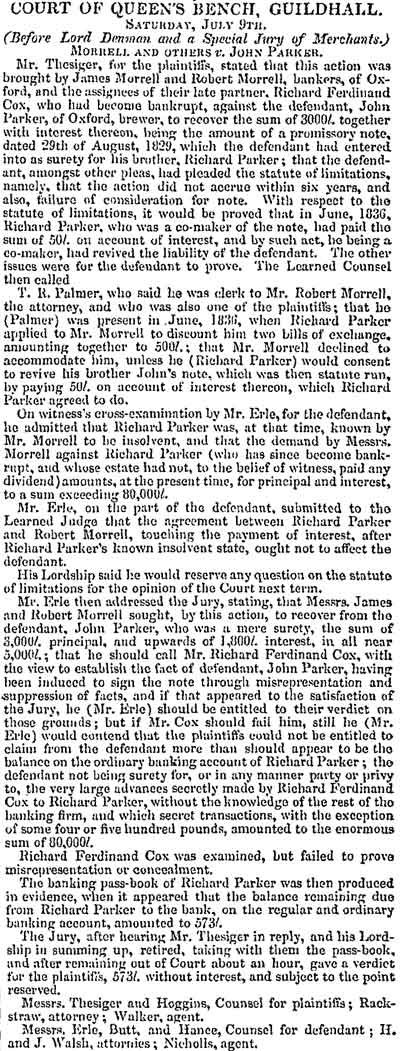
The following case was reported in Jackson’s Oxford Journal on 16 July 1842:
On 22 November 1842 a report in The Times of the case of Leake v. Loveday and Another in the Court of Common Pleas included the following:
From the evidence given on the trial [at the last Oxford Assizes], it appeared that a person named Richard Ferdinand Cox had, previously to the year 1838, been in partnership with Messrs. Morrell, bankers at Oxford, and that while the partnership continued, Cox was permitted to occupy apartments in the upper floors of their house of business. In 1837 the plaintiff became the purchaser of some goods belonging to Mr Cox, which had been seized under an execution, and the Jury found that this purchase was made bona fide; but it was further alleged, on the part of the plaintiff, that an arrangement was then entered into between him and Cox, by which Cox attorned tenant to the plaintiff of the apartments over the banking-house at a rent of 5s. a week, and became also tenant of the furniture which Mr. Leake, the plaintiff, had purchased under the execution. It was not proved that Cox had ever paid one shilling of rent to the plaintiff, and on the 5th of December, 1838, a fiat in bankruptcy was issued against Cox, and certain persons were chosen his assignees. Cox, however, remained in possession of all the furniture till the month of July, 1841, when the plaintiff put in a distress upon the premises for all the alleged bygone weekly rent. Upon tis proceeding reaching the ears of Messrs. Morrell, they immediately commenced an action of ejectment, and having obtained judgment against the casual ejecter, sued out a writ of habere facias possessionem, and turned the furniture out of the apartments lately occupied by Cox into the street. The goods, however, were removed immediately, for the purpose of protecting them from the weather, into a neighbouring empty house, and the plaintiff was informed of that circumstance, but he refused to take possession, having at that time before his eyes the agreeable prospect of a successful action against the sheriff. Another execution was sued out against Cox, and the goods in question were seized by the sheriff under it, and sold on the 26th of July, 1841. The assignees under the fiat set up their claim to the proceeds of the sale, and having given the sheriff an indemnity, had the money paid over to them.
† Richard Ferdinand Cox died at 19 Nelson Square, Christchurch, Surrey at the age of 58 on 16 June 1845 and was buried at All Souls Cemetery, Kensal Green on 21 June.
Jackson’s Oxford Journal for 4 March 1848 reported on Parker v. Morrell in a Nisi Prius Court held the previous day:
to try whether a bond and warrant of attorney for 250l., dated the 30th of April 1831, had been obtained from the plaintiff by the present defendants or by Richard Cox or Richard Ferdinand Cox (their late deceased partners), by fraudulent misrepresentation, or by fraudulent concealment, or both; and whether he had signed them as surety for his brother Richard Parker.
The Judge found in favour of the defendants.
The widow of Richard Ferdinand Cox
At the time of the 1851 census Sarah Cox (62) was described as an annuitant and was lodging at 2 St Aldate’s Street in the household of the confectioner Thomas Biggerstaff. She died in St Aldate’s parish at the age of 69, and her funeral was held at All Saints’ Church on 6 March 1857.
The only child of Richard Ferdinand Cox
Louisa Sarah Cox (born 1813) was on 12 August 1843 appointed one of the executors of the Will of her widowed aunt, Elizabeth Hanwell. Mrs Hanwell chose as her other executor the Revd James Thompson a Fellow of Lincoln College, Oxford.
The Revd Thompson was appointed Rector of Cublington in 1845, and on 28 August that year he married his co-executor Louisa Sarah Cox at the Church of St Martin-in-the-Fields in Middlesex , with James's residence given as Cublington in Berkshire and Louisa's as Cockspur Street in St Martin-in-the Fields. (Mrs Hanwell died near the end of 1846, and her will was proved on 11 November that year by the newly married couple.)
At the time of the 1851 census Louisa was living in the Rectory at Cublington in 1851 with her husband the Revd James Thompson and their three sons: James Thompson (4), William Frederick Thompson (3), and Henry James Thompson (2). Her husband was appointed Rector (head) of Lincoln College, Oxford in 1851, and died at the Rector's Lodgings there at the age of 60 on 26 December 1860.
At the time of the 1861 census Louisa, described as a fundholder, was living at 24 Beaumont Street with her three sons, now aged 14, 13, and 12, and two servants.
Louisa Sarah Thompson, née Cox died at 24 Beaumont Street l 1865 and her funeral was at All Saints Church on 19 November.
See also:
- Richard Cox, Mayor in 1799, 1812, and 1813 (Richard Ferdinand Cox’s father)
- Brigid Allen, Morrells of Oxford. The Family and their Brewery 1743–1993 (Oxfordshire Books, 1994), pp. 38–9
