

Catte Street

Catte Street originally only ran northwards as far as the city wall, which in effect is the present New College Lane junction. The west side was in the parish of St Mary-the-Virgin and the east side in the parish of St Peter-in-the-East (except for the side of All Souls College). .
Hence until the twentieth century the part to the north of New College Lane was actually the eastern side of Broad Street and was in a different parish (Holywell). More information about the top part of the present Catte Street can be found here under Broad Street East:
- 28–30 Broad Street (including the octagonal chapel, and now part of Hertford College)
- 31–34 Broad Street (now the side of the Old Indian Institute).
Catte Street to c.1807
This street was recorded as Kattestreete in the early thirteenth century
In 1442 it was Mousecatcher’s Lane.
This map shows Catte Street in c.1600 just before the Bodleian Library was built on its west side.
In the eighteenth century it was known as Cat Street again. The building of the Radcliffe Camera in 1737–49 greatly altered the street.
Catharine Street c.1807–1930
At some point between 1805 and 1808 Cat Street was given the more respectable name of Catharine (or Catherine) Street.
This drawing of Catherine Street made by J. C. Buckler in 1822 shows the houses in front of New Magdalen Hall that were about to be demolished.
The photograph on the postcard below shows Catharine Street (spelt Catherine) in c.1900:
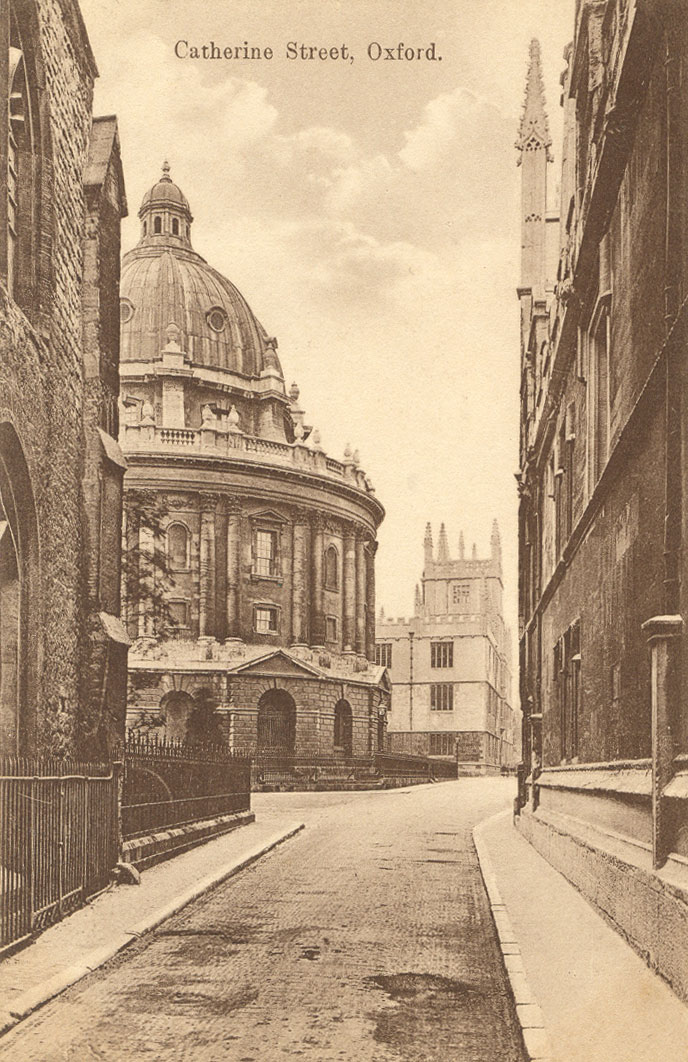
In 1913 Hertford College expanded northwards, linking Catharine Street to Broad Street east with a bridge to a rebuilt college building on the site of 28 Broad Street. Then in 1923 it also demolished 30 Broad Street and rebuilt the former octagonal chapel at No. 29. The northern part of the college was thereafter deemed to be in Catharine (Catte) Street. but the Indian Institute's address remained Broad Street, as it is today. Hence Kelly's Directory for 1930 simply listed Hertford College under Catharine Street.
In 1921 the poet Robert Bridges wrote in his preface to H. E. Salter's brochure entitled The Historic Names of the Streets and Lanes of Oxford intra Muros, “If the silly modernist St Catherine Street was done away with and the historic Cat restored, there is I believe no single human being whose affairs would be in any way affected.” This change took place nine years later.
Catte Street, 1930 to the present
In December 1930 the city council restored the original name, spelt as Catte Street as in the fifteenth century. This may have been to avoid confusion with the Catherine Street in East Oxford (which had been built in the 1870s when that area was still part of Cowley).
Hertford College continued as before to be the only occupant of Catte Street listed in Kelly's Directory.
The south end of Catte Street has been completely closed to motor vehicles since 1973.
Some early occupants of Catte Street
(1) Cat Street prior to 1808
On 16 May 1767 Mr Andrews advertised his stationery and music shop in Cat Street.
The Survey of Oxford lists the following occupants of Cat Street in 1772, running south to north (with the measurement of frontages in brackets):
West side (St Mary the Virgin parish)
East end of St Mary's Church (31yds 1ft 6in)
St Mary's churchyard (14yds 1 ft 0in)
Area of Ratcliffe's Library (99yds 1ft 3in)
Publick Schools (58yds 0ft 3in)
[This is followed by the yard of the Printing House, at the back of the Clarendon Building in Broad Street]East side (St Peter-in-the east parish except for All Souls)
All Souls College (138yds 1ft 1in) [the side of the college, which was in St Mary-the-Virgin parish)
Hartford College stables (19yds 0ft 0in)
Mr Holman (6yds 0ft 10in)
Mr Terrant (14yds 2ft 0in)
Hertford College (14yds 0ft 8in)
Mr Lay (5yds 1ft 4in)
Mr Mason (7yds 1ft 8in)
Mrs Makemalt (7yds 0ft 0in)
[Here New College Lane]
On 12 June 1779 Dick's Coffee House in Cat Street was advertised as being to let.
In February 1793 there was a hairdresser & perfumer called Mr T. Gillart in Cat Street: he died on 3 March 1797.
The saddler Mr Halse had premises in Cat Street in May 1797.
The surgeon Samuel Vowles died of gout of the stomach in 1805 when he had premises in Cat Street in the home of William Lay, a cook of Brasenose College who already held the property at the time of the Survey of Oxford in 1772. Samuel's widow Jane Vowles continued to run her husband's practice here after his death. Both husband wife claimed to be able to cure “cancers and wens".
On 18 January 1806 the forthcoming auction of a freehold house adjoining Hertford College in the occupation of Mr Gill and another one adjoining that house occupied by Mr Lay was advertised.
(2) Catharine Street from 1808
The first mention of Catharine Street in Jackson's Oxford Journal is on 12 November 1808 when Mrs Vowles, the Executrix of William Lay (who had died on 24 August 1808) requested that those indebted to him should pay her at Catharine Street.
On 14 April 1810, a “neat dwelling house” in Catharine Street owned by the city and occupied by Mr Lawn, was advertised as being for sale.
By January 1818 the London Boot and Shoe Warehouse had premises in Catharine Street, run by Thomas Randall.
On 24 December 1852 the city council agreed to provide a branch sewer to Catharine Street.
The Post Office Directory for 1867 lists the following.
Catharine Street:
Mary Hall (Saint) [original home of Oriel College in the Rectory of St Mary-the-Virgin Church]
Magdalen Hall [refounded as Hertford College in 1874]
Bodleian Library
All Souls' College
St. Mary's Church
Brasenose College
Gadney, S.
Bickerton, Joseph
Hayward, H.
The inclusion of Brasenose College in the above entry indicates that part of St Mary's Lane on the western side of the Radcliffe Camera and St Mary-the-Virgin Church itself were then considered to be part of the street:
