Oxford Mileways Act and the High
The First Schedule of the Oxford Mileways Act of 1771 lists those ways and streets “to be paved, widened, and repaired, exclusive of the Mile-Ways”. These include:
- “The Street or Way leading from Magdalen Bridge to East Gate, called Bridge Street
- “The Street or Way called the High Street, leading from thence to Carfax”.
The measures listed in the Second Schedule include:
- In order to rebuild and widen Magdalen Bridge,
To take down a Malt-house or other Buildings, and the several Houses built upon or situate on the South and North Sides of the said Bridge, and such other Buildings as shall be necessary for rebuilding the said Bridge, and widening the Avenues leading thereto, and to purchase such Ground as shall be necessary for carrying off the Water from the said Bridge - In order to open the Bridge
Street, from the West End of Magdalen Bridge to the East End of the High
Street,
To take down the House and other Buildings in the Physick Garden, and such other houses, Buildings, and Walls, near Magdalen College, as shall be necessary for that Purpose;
To take down the East Gate, and such Houses and Buildigns near or adjoining to it, on the South and Nort Sides of the said Street, and to purchase such Ground as shall be necessary to render the Street of an equal Width with the High Street - In order to open the Street near Carfax,
To take down Carfax Conduit.
Thus until 1771 a mean road known as Bridge Street ran from St Clement’s to the site of the old East Gate near Merton Street, and only then did the wide High Street begin.
Pavements
Early prints of the High Street show that it had no pavements, but on 20 April 1776 the following notice appeared in Jackson's Oxford Journal:
OXFORD PAVING ACT.
AT a Meeting of the Commissioners, held the 15th Instant, IT WAS ORDERED, That the North Side of the High-Street, from the West End of Carfax Conduit to the East End of Mr. Lock’s Shop, in the High-Street (No. 7), shall be paved two Feet and an Half wide, from the Front of the Houses, with square Pitchers;—the South Side of the said High-Street, from the west Corner of Mr. Bennet’s House, near Carfax Conduit, to the Point opposite to the East End of All Saints Church, with raised Flag Pavement, about seven Feet wide; and the Carriage-Way, from Carfax Conduit to the East End of All Saints Church, to be pitched in a convex Form.—The Paving to be of the best Weather Northleigh Stone, not less than three Inches thick in every Part thereof, and no Side of any Stone to exceed Twelve Inches, nor be less than nine (except the Closures;) The Curb to be laid flat; and to be twelve Inches wide, seven Inches thick, and not less than two Feet six Inches long, the Joints Joggled, and the Whole of it back-jointed, to receive the Paving, and to be executed under the Directions of the Surveyor.—For further Particulars apply at Mr. Gwynne’s Office, at Magdalen Bridge, where a Model of the Work may be seen.
Persons willing to contract, are desired to send in their Proposals, sealed up, to one of the Clerks, on or before the 27th of April Instant.
N.B. The above Paving and Pitching to be contracted for by the Yard Square, the Curb by the Foot Running Measure; and the Contractor to specify in what Time the Work will be compleated.
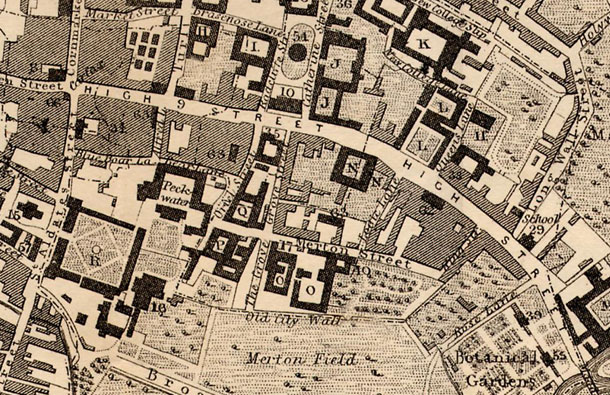
Lowry’s map of c.1860 (below) shows the full length of the High much as it is today.