

22–23 Cornmarket Street: T. G. Jones (was W. H. Smith)

The photograph above, taken in 2009, shows the two shops now occupied by T. G. Jones (formerly W. H. Smith & Son) and owned by Jesus College. Both houses on this site have always been in the parish of St Michael-at-the-Northgate Church.
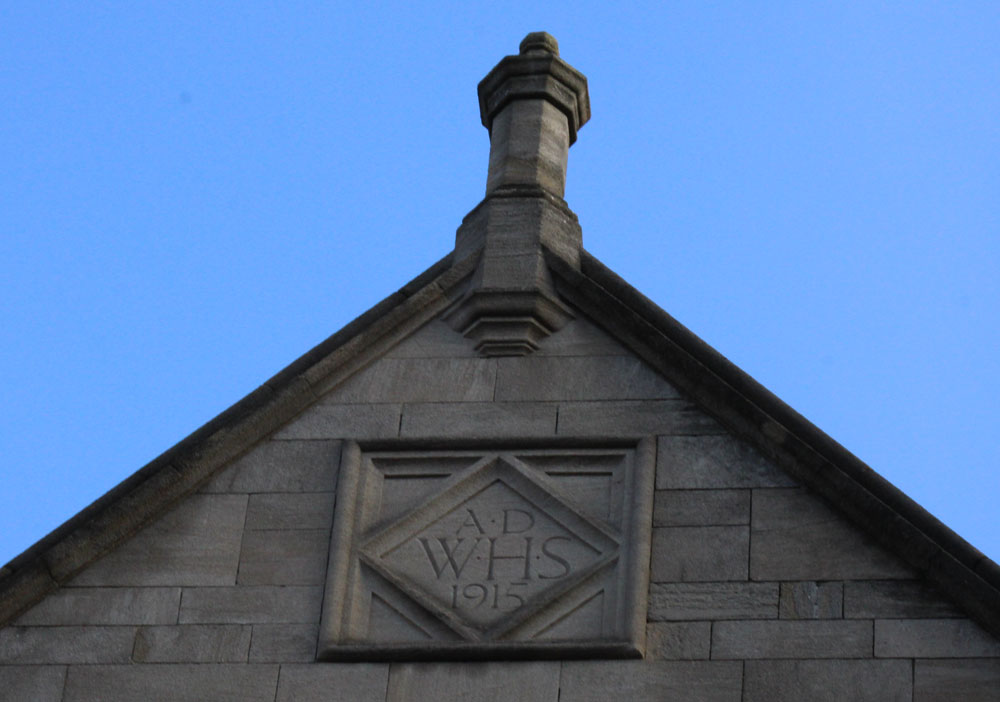
The right-hand shop is the original W. H. Smith shop at 22 Cornmarket which was purpose-built in 1915: the inscription in its gable, shown below, reads “A.D. / W.H.S / 1915”.
On the left is the much older seventeenth-century shop into which W. H. Smith expanded in the late 1970s.
At ground-floor level, the modern shop front spanning both shops dates from 1969, when extensive work was undertaken here.
It was announced in March 2025 that all the W. H. retail stores were being sold to the investment company Modella Capital and would be rebranded as T. G. Jones (a deliberately made up name), and their new sign went up on this shop in October 2025.
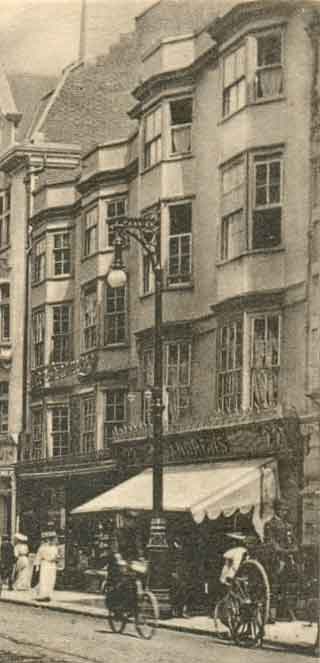
No. 22 to the south used to match its neighbour to the north (see photograph, right). Another photograph showing the matching pair of shops and their neighbours on each side in the 1890s can be seen here
No. 23 to the north is a Grade II listed building (list entry 1185685). It is in origin a seventeenth-century timber-framed house which was refronted in the eighteenth century and since restored. A seventeenth-century staircase and some eighteenth-century panelling survives at the back.
Right: Nos. 22 & 23 Cornmarket Street. The pennyfarthing bicycle parked outside No. 22 (with the name of the draper ANDREWS over the door) suggests that this photograph dates from the late nineteenth century. No. 22 then had two bay windows on each of its upper floors, matching No. 23
The former No. 22
In 1772 a survey of every house in the city was taken in consequence of the Mileways Act of 1771. According to H. E. Salter, 22 Cornmarket was then in the occupation of Mr Clark, and had a frontage of 9 yards, 0 ft. and 3 in.
The grocer Daniel Bolton had his shop here until July 1836, when he retired because of his health, and the tea-dealer and grocer Richard Cross reopened the shop on 1 August 1836. At the time of the 1841 census Richard Cross was living here with Ruth Cross, a shop assistant, and a servant. Listed separately as living in part of Cross's house was the architect John Derrick, his wife Elizabeth and their two children, plus their servant.
This leasehold property was advertised for sale thus in Jackson’s Oxford Journal of 8 January 1859:
All those extensive BUSINESS PREMISES,
No. 22, CORN MARKET STREET, Oxford;Comprising on the ground floor, a double-fronted shop, counting house, and spacious dining room, detached kitchen and scullery, with store rooms over; on the first floor, a lofty and elegant drawing room (26 ft. by 16 ft.), and two bed rooms; on the second floor, a sitting room and three bed rooms; on the third floor, three attics. In the basement, coal, cellar and warehouse; and a yard and garden at the back, the whole possessing a frontage of 27 ft., and extending a depth of upwards of 165 ft., in the occupation of Mr. Cross, grocer, under a repairing lease, of which two years will be unexpired at Lady Day next, at a rental of £125 per annum.—This Property is Freehold and Land Tax redeemed.
The grocer Richard Cross continued to rent the premises to 1881. He was followed by the wine & spirit merchant William John Mayo.
In 1899 the draper Charles Andrews moved in.
W. H. Smith had moved into No. 22 by 1921.
In 1968 Jesus College was granted permission to extend and rebuild No. 22 (68/18400/A_H).
The present No. 23
Salter states that in 1771 No. 23 was occupied by Mr Terry and had a frontage of 9 yards, 0 ft. and 5 in.
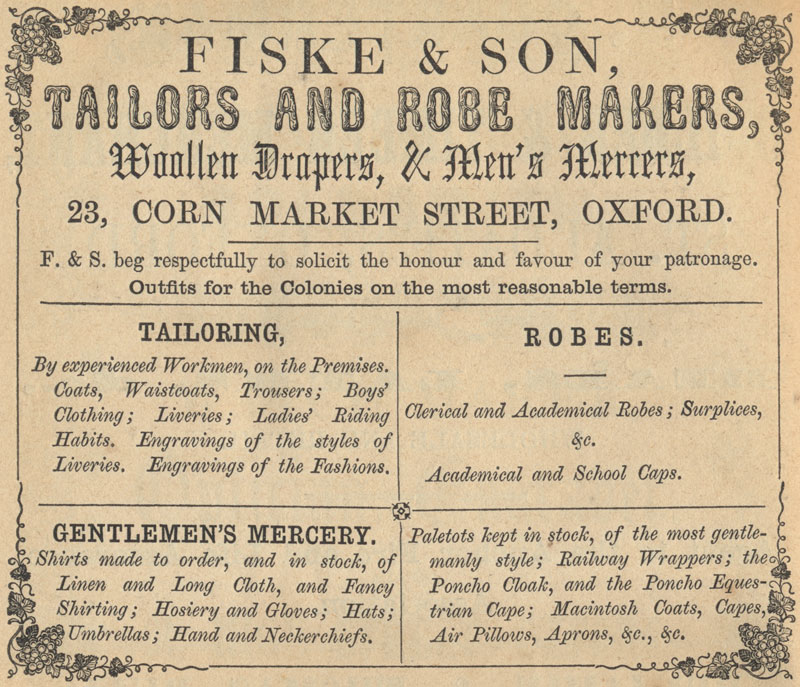
The tailor Jonathan Fiske had settled in Oxford after his marriage to Esther Spink in 1809, and a poll book of 1825 shows that he then was a draper in St Michael's parish, probably at this shop: he was certainly here by 1830. He can be seen living at the premises at the time of the 1841 census with his wife and his sons John (who was also his apprentice) and Frederick, a boy called Marshal Spink, a shop assistant, and three servants. He died here on 6 October 1852, and his unmarried son John Marshall Fiske (sometimes John Marshall Spink Fiske) took over the business. The following advertisement appeared in Billings Directory for 1854:
Jonathan Fiske's widow Mrs Esther Fiske continued to live at 23 Cornmarket Street with her son, and died here on 19 November 1862 at the age of 82. By 1871 Messrs Fiske & Son were described as jewellers as well as tailors.
On 8 February 1873 Jonathan Fiske announced in Jackson's Oxford Journal that he had retired from business and would be succeeded by Messrs Lewis, Sons, & Parker, tailors of 18 St James's Street, London, who would move their Oxford shop here from 12 Turl Street. They remained here for eight years. On 11 June 1881 a forthcoming auction of the stock-in-trade of a tailor and robe maker was advertised by direction of Messrs Lewis, Sons, & Parker, who were relinquishing their Oxford branch establishment.
The boot & shoe makers Gillman & Son started business in Holywell Street in 1861 and then moved to George Street. In about 1885 George Gillman opened a branch here at 23 Cornmarket Street. At the time of the 1891 census his parents, the bootmaker Richard Gillman (73) and his wife Mary, lived here over the shop. He died near the end of 1894, and his furniture and effects were advertised for sale in Jackson's Oxford Journal on 21 September 1895. The firm continued to trade here to 1936, and was still in business at 12 Broad Street up to 2002.
By the late 1970s W. H. Smith expanded their shop at No. 22 to include No. 23 to the north.
The shop became T. G. Jones in October 2025.
Occupants of 22 Cornmarket and 23 Cornmarket Street listed in directories etc. |
||
Date |
No. 23 (left) | No. 22 (right) |
1830–1872 |
Jonathan Fiske Fiske & Son, Woollen draper (1846–1867) Fiske & Son |
To 1838: Daniel Bolton, grocer
Richard Cross (from 1838) |
1873–1881 |
Lewis, Sons, and Parker (of London) |
|
1885–1899 |
Gillman & Son |
William Mayo, Cigar stores (from 1890) |
1899–1914 |
Charles Andrews, Draper |
|
1915–1936 |
W. H. Smith & Son |
|
1938–1968 |
Greens Gowns/Samuel Green, Costumier |
|
1970–1972 |
Richard Shops Ltd, Fashion specialists |
|
1973–1976 |
Ramsey & Muspratt, Photographers |
|
1979–2025 |
W. H. Smith & Son |
|
2025– |
T. G. Jones |
|
22 & 23 Cornmarket Street in the censuses
1841
No. 22 was occupied by the grocer Richard Cross (25) and his wife Ruth (20) with a shopman William Tarrant and one female servant. In “Part of Cross House” is the architect John Dooricks (35) with Elizabeth (30), John (4), Edward (3), and one female servant.
No. 23: Jonathan Fiske, a tailor, lived here with Esther (60), John (c.20), his son and assistant, and Frederick (c.20). Also in the household were Marshal Spink (15), James Brown (who worked in the shop), and three female servants.
1851
No. 22: Richard Cross (38), grocer, still lived here with his wife Ruth (32) and their children Thomas (8), Ruth (7), Elizabeth (5), Richard (4), Priscilla (2), and Jane (1). They had two female servants, and a shopman lodging with them. In the other part of the house were two visitors: William L. Wigan, the Vicar of East Malling in Kent, and his wife Caroline (20).
No. 23: John M. Fiske (34), a woollen draper described as the son of the head of the household [Jonathan Fiske], lived here over his father's shop.
1861
No. 22: Richard Cross (49), grocer, still lived here with his wife Ruth (44) and his children Thomas (18), who was a grocer’s assistant, Ruth (17), Priscilla (12), Ellen (9), Samuel (8), Sarah (7), Fanny (4), and Jane (six months). They had two house servants, and and an apprentice, Samuel Dutton (15), also lived with them.
No. 23: John Marshall Fiske (44), a woollen draper who now employed twelve men, was still unmarried and continued to live here over his shop with his mother Esther (81), one draper’s assistant, and two house servants.
1871
No. 22: Richard Cross (57), grocer, still lived here with his wife Ruth (54) and their children Thomas (28), who was his father's assistant, Elizabeth (25), Priscilla (22), Helen (19), Sarah Ann (17), and James (14). They had two servants, and a grocer's shopman lived with them.
No. 23: John M. Fiske (54), woollen draper, still lived here with one servant. Living with him was a shopman who worked for him.
1881
No. 22: Richard Cross (68) still lived here with his wife Ruth (63) and their daughter Ruth (37) and son Samuel (27), described as a grocer’s assistant. They had one general servant.
No. 23 was occupied by Emma Parker (a widow of 50), described as both the head of the household and a housekeeper, and her unmarried sister Sarah Ann Parker (38), a confectioner’s assistant.
1891
No. 22: William John Mayo (35), wine & spirit merchant, lived here with his son Guy (8) and a sick nurse and a general servant. His wife Fanny was paying a visit with her father to Matlock, Derbyshire.
No. 23: Richard Gillman (73), bootmaker, lived here with his wife Mary (73) and their unmarried daughters Mary (36) and Rose (34). They had one general servant.
1901
No. 22: Charles Andrews (51), a draper, lived here with his wife Charlotte (51), who was a milliner. They had two domestic servants, and a milliner and a saleswoman also lived with them.
No. 23: Harriet Gillman (54), a widowed shopkeeper (and employer) at the bootmaker's below, lived here with her children Olive (15) and Ronald (14), plus a housekeeper and general servant.
1911
No. 22: Charles Andrews (61), a fancy draper, still lived upstairs in twelve-roomed premises with his wife Charlotte (61), who was a milliner, as well as an assistant milliner, two saleswomen, a cook, and a housemaid.
No. 23: No listing: possibly it was part of No. 22 upstairs.